








Colorado State University Athletics
11/12/2026 2:00:00 PM | Football
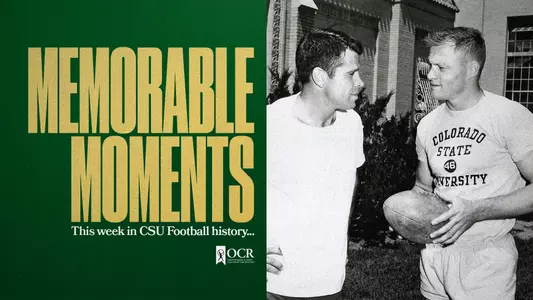
Tales tell the entire story of the football program
Gary Glick, arguably one of the greatest CSU football players of the pre-Hughes Stadium era, walked into the Hughes Room at Hughes Stadium and sat down after seeing a newly unveiled banner on the concourse of the stadium with his photo. The 32 banners, placed where the conference flags used to be on both the south and north concourses of the old stadium, were unveiled in 2011 to honor different Ram Legends of football from the early days to more modern times. Glick, excited to see history from his time at Colorado A&M said, "All we old players want is to be remembered. These banners help make that happen."
Since research into CSU's football history started for the book Aggies to Rams, nearly 100 former football players have been interviewed and documented to tell their stories. The oldest player, Charles Bresnahan, played for Harry Hughes in 1919 and 1920. He was interviewed on the sideline of a game just before he was inducted into the school's Hall of Fame in 1992. He wanted to make it clear in his brief interview that Hughes was the reason he loved playing at CSU so much.
That statement from Bresnahan was echoed in interviews with Earle Lory, son of Charles Lory, Norm Cable, star of the 1930s and John Mosley, the first modern day black football player whose No. 14 is now retired throughout the school. Hughes' impact was told over and over again by his former players in every interview or written letter about the "Dean of American Football Coaches." Hughes was described by Cable as, "tough but fair,' while Zenas Brush said Hughes sometimes taught his players how to shave properly or about sex education.
Mosley was among the best of players to talk about Hughes, playing at Colorado Field in the early 1940s and the impact Hughes' assistant coach, Hans Wagner, had on him and his team. Mosely's most retold story was when the team traveled to Salt Lake City in the early 1940s, Hughes took the team to a movie as he usually did on road trips. Mosley approached Hughes just before the movie started and said the theatre management told him he had to move to the balcony due to his color, but Hughes had none of that. Hughes and Wagner quickly stood up, told the team that If we don't sit together, we don't stay in this theatre.
Frank Faucett, kicker and halfback from 1948-1950, told many great stories about his time as a player for Bob Davis. Davis is likely the most underrated coach in school history and Faucett, who passed away in 2023, always wanted people to know what a great coach Davis was to his athletes. While Davis was a great coach, Faucett said he received a nickname amongst his players of "the whip," because he would whip his team into shape for each week's game.
Gary Glick, Lee Walters, Ollie Woods, Al Dorsey, Tuffy Mullison, and the great Fum McGraw among many others all echoed what a great coach and person Davis was from 1947 to 1955. Davis could connect with his players and also acted as a scout for the NFL's Detroit Lions. He died of cancer in 1965, another reason several of his players continually wanted his legacy remembered, because so many people didn't have a chance to know him in more modern times.
Players from the 1960s and 1970s have also wanted their stories told, whether it is former quarterback Bob Wolfe, who wants us to know the third down of the famous Bounce Pass was not purposely played to be caught, or it is Larry Jackson, who even after more than 25 years of integration on the football team, still faced discrimination in the 1960s, their stories are ours to listen to and understand.
In one very memorable interview conducted in his offices at Coors Field, then Colorado Rockies President Keli McGregor spoke about playing in the 1980s and the hard times that had fallen on the program. The All-American tight end told the story that funding was so tight at CSU, the team flew to Albuquerque for a game against New Mexico, had a light lunch, played the game and then flew back to Fort Collins to save money on hotel costs, all in the same day.
Players from the 1990s reflected on the glory days of CSU, but also on their great coach Sonny Lubick. Just like Hughes, Lubick's players always had great things to say about the legendary coach and wanted to emphasize that while we still know Sonny today, his impact was greater with players than fans will ever know.
Gary Glick's comment that former athletes want to be remembered is not just a record of history, but for fans and modern-day players to understand what it was like and how difficult it can be to play football in every decade that has been recorded. These are the memorable moments, we as fans need to hold sacred, knowing that 1,000s of men have played football at CSU and they all have a story, whether good or bad, they all mean something.
Monday, November 09
Saturday, November 07
Saturday, November 07
Monday, November 02