


Colorado State University Athletics

Colorado State

San Diego State
Shootaround: Rams Muscle Through
3/12/2026 4:03:00 PM | Men's Basketball
CSU focuses on resilience before taking on No. 2 San Diego State
LAS VEGAS — Muscle only grows after it tears.
For much of the season, the Colorado State roster has felt like it was weight-training with its rotations — constantly adjusting and rebuilding. With half the roster new, along with a new coaching staff, certainty in what came next was hard to come by. But the process of getting stronger rarely moves in a straight line.
CSU fans saw that early in the season when Rashaan Mbemba and Kyle Jorgensen went down with injuries. Despite not seeing time on the hardwood, both continued putting in the work behind the scenes.
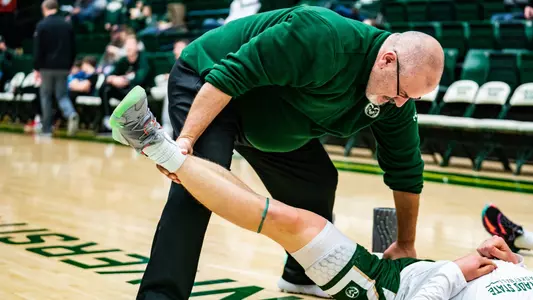
It's something the CSU support staff knows well — the people who form the team behind the team. A collective of nutrition, strength training and sports medicine working together to build a carefully balanced support system.
"We work together to make sure we have all our bases covered because nutrition plays a really big role in obviously fueling them in recovery," said Megan Skinner, CSU's nutrition specialist. "You need all those other pieces in place to make it most effective. So I'd say we're part of the bigger team."
The bigger team consists of Skinner, strength and conditioning coach Jason Phillips and athletic trainer Madison Corona.
The three work in tandem to understand the "why" behind the precision work — the weight-room exercises, game-day meal plans and injury-prevention routines. Because the health of a roster of 14 Division I athletes rarely falls on one person's shoulders.
Instead, it requires something closer to a choreographed dance.
"They have good buy-in when they get what they're doing," Corona said. "I don't know a lot of 18- to 22-year-olds that like to do things because someone told them to. So I do think you have to help them understand the why. But they're all fairly responsible, I would say."
Behind every action is a reason. Sometimes it just takes a little coaxing to understand what that reason is.
Because shooters like to shoot, and players want to play. So when an injury or illness presents itself, the focus quickly shifts to the process of getting back on the court. Those are the behind-the-scenes moments where the staff shines most — the work which rarely reveals itself during a game inside Moby Arena.
"I think that's the part of that injury process that not everyone sees," Phillips said. "They show up on game night, and they see them sitting in their street clothes on the bench. What they don't see is all the time and effort that we continue to put in with those kids behind the scenes.
"Extra conditioning, extra lifting so when they do get healthy and that injury is healed now, we can jump right back in where we left off from a performance standpoint."
Recovery doesn't begin and end in the training room. It carries into the weight room and even the cafeteria.
For Skinner, fueling athletes properly is another piece of the recovery puzzle. Access to food, understanding nutrition and learning how to build meals that support both performance and healing all become part of the equation.
"I think education is a huge part of what I do," Skinner said. "A lot of these guys want to know the why behind it, too, which is a good thing. You teach them why these things are around them and how they're going to help them perform better as a basketball player.
"They have the choice to do it. But once they're bought in and they understand, it becomes an easy choice for them."
Because strength isn't built only through repetitions — it's built through consistency.
Teaching athletes the reasoning behind those habits often becomes the most important step.
It's a process rooted in resilience.
"It's kind of like a checking account," Phillips said. "We're putting deposits in the account, so when we get to the end of the season and we have to write checks we got to make sure that we got enough in there to cover the balance. That's kind of the analogy that I use. We're not doing a ton of work in the weight room right now, but hopefully the things we've done leading up to this have put us in a good position to be healthy, to be strong, to be resilient. They've got to trust in that process and trust that they've put in the work.
"Now it's the most critical time of our year and they know they're prepared for what's being asked of them."
Phillips' analogy reflects the long view the staff takes with the roster. The work done in summer workouts, preseason lifts and early-season recovery sessions accumulates long before the most meaningful games arrive. When they face a gauntlet of four games in four days.
By the time March approaches, the goal isn't to build something new — it's to trust what has already been built.
And much like the game of basketball itself, the trust is often tested in the toughest moments. Whether a team is down two points or 10, the decision to keep fighting is what keeps the game alive.
"I think it definitely builds resilience, and it also reminds them why they want to be out there," Corona said. "When it's kind of taken away from you, you remember the joy it brings you to be out there with your teammates — even in the hard times, even when things aren't going your way — because at least you get to be in the fight. It gives them perspective. It allows them to lean on their teammates, let their teammates lean on them as well, and create some camaraderie from that standpoint."
Time away from the court can reshape a player's perspective.
Rehab sessions replace practice reps. Conditioning drills take the place of game minutes. Progress is measured not in box scores but in small milestones — a little more mobility, a little less pain, another step closer to returning.
Meanwhile, the support staff keeps the long-term picture in mind. Each lift, each meal plan and each rehab session becomes another step toward rebuilding strength.
Most fans will never see that part of the work.
They see the player sitting on the bench in street clothes. They see the absence in the lineup.
It all remains a part of the bigger picture though. Because sometimes it takes a little damage first — some microscopic tears in muscle — for the strength to finally reveal itself.
In the Paint
CSU is facing its second matchup of the Mountain West Conference Championship against No. 2 San Diego State in the quarterfinals. … CSU comes in after edging out a win against Fresno State and SDSU comes in well-rested after earning a first-round bye. … The teams split the regular season series this year. … Historically SDSU holds the edge in the matchup all-time 54-46. … The last time the two teams met in the tournament was 2023 in the quarterfinal game where the Aztecs eventually went on to win the championship.