
Colorado State University Athletics
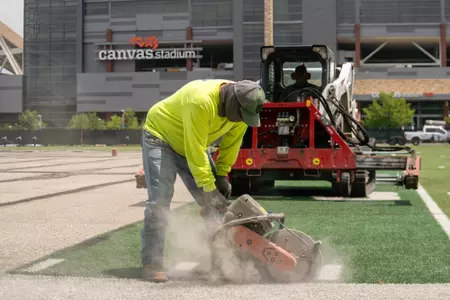
Surface Improvements Which Go Well Beyond
6/25/2026 12:00:00 PM | General
CSU replaces turf, court in front of 2026-27 season
The time had come, and the moment made it rather fitting. As Colorado State athletics enters the Pac-12, the two main surfaces it was set to host competitions on were going to need a bit of sprucing when it came to branding.
Additionally, the court at Moby Arena and the turf at Canvas Stadium were both due needed upgrades. The floor at Moby hadn't been completely renovated for 25 years, while the playing surface for football was the original product from the 2017 opening.
"It was time. The fun part is there's always time when these things need to be repaired," said Mark Paquette, CSU's associate athletic director for facilities and game management. "We are so fortunate to be able to do this right now.
"It's been tremendous because we will get to go into the Pac-12, which is a great celebration. It's a great story for us to set out there. This is the commitment. This is what getting to the Pac-12 gets you, and this is what is going to help us be competitive and excel in the Pac-12."
The work began in earnest in late May, after high school graduation ceremonies were held at Moby Arena. That project is slated to be completed by July 17. This week, the turf at the football practice fields started to come up and is expected to be replaced on July 21. A day later, the process will start again at the indoor practice facility, one set to continue through Aug. 11.
As for the stadium, changing the turf is scheduled to start July 16, a handful of days after the three days of PBR concerts and rodeos with a finish date of Aug. 7.
Building construction schedules weren't the only thing on Paquette's mind, knowing three teams count on the Moby floor in the summer and multiple entities are lined up for the IPF, which is the busiest building in the offseason.
"By far it was the IPF. Camps and such are scheduled years in advance. That benefit will be seen by a lot of folks, including campus recreation," Paquette said. "Campus rec uses it extensively during the summers and in the evenings.
"That'll be a real bonus on that, and what's cool about that one is every team will benefit from that improvement. We've done several projects over time, and it may be a couple of teams that it does help. Or certain teams at certain times get benefit. Here's one project that every team is going to see the benefit."
Every surface deals with normal wear and tear, especially in the Colorado climate. While the court at Moby had been spruced up a few times, a quarter of a century was testing the quality of the sub-surface for three major tenants.
Scott Sidwell, the deputy director of athletics and the chief operating officer, said it became clear the time had come for all of the facilities to get an upgrade.
"There's an underneath layer to all basketball courts. Sometimes over time you get dead spots. It's not as springy," he said. "It's maybe a little bit springier here versus there. So, again, these things are all coinciding with us going into the Pac-12. One of the things that we've talked about a lot is we have to elevate everything that we're doing from the foundation layer on up.
"These are the things that are necessary. It's not just about what you're doing to compensate your teams and do those types of things. These are the things that we have to do to compete at a very, very high level."
FieldTurf was selected to replace the three fields. They did the turf inside the IPF, which is still the original product from 18 years ago, but the stadium and practice fields are currently from another company.
FieldTurf, which installed the turf at Hughes Stadium, is one of industry leaders and is currently at six NFL stadiums, including the heavily populated Mercedes-Benz Stadium in Atlanta. Colorado State selected the top tier, the Vertex Core, for all three sites on campus. There are three levels to it, incorporating 9.2 pounds of infill per square foot, standing 2.5 inches tall.

"When John Gilman started this company, he wanted to emulate a high-end natural grass field. So, the 9.2 pounds per square foot is really a characterization of he cut a square foot of high-end natural-grass field and weighed it and looked at the composition of it, and he wanted to emulate that," said Jed Easterbrook, the company's regional vice president. "That's where we have our three layered system that actually will feel like a high-end natural grass field to the players. So, when you, and we have several coaches that will walk on our fields and say, oh, this is a FieldTurf field. It's the safest product on the market.
"It's firm, it's fast, but it's most importantly, it's safe."
The company cites the research of Dr. Mike Myers, who has compared different turf systems and natural grass for more than 20 years. Since FieldTurf is not all rubber, there is less energy "bounce back" to the body, and it is designed for cleats to react more naturally in planting and releasing.
The shelf life of the fields is about 10 years, depending on usage, and Easterbrook said FieldTurf is committed to making the playing surfaces last.
"One of the things we're doing with CSU is we're actually implementing an annual maintenance program, so we're going to come in every year and make sure that infill is correct and it's a proper depth," he said. "If it's not, we're going to replace that infill where needed, so we're going to be able to maintain these fields for the next 10 years."
This period of time represents an abundance of change for Colorado State as a university, and the athletic department sees it as a chance to show it is fully committed to being a frontrunner in all instances of the Pac-12.
With facility upgrades needed, there was no time like the present to fully invest at a high end, not just a fresh coat of paint.
"To me, at the end of the day, it speaks to the commitment that the institution is making to be great. When you do that, that helps in recruiting, that helps in retention, that helps in people looking at you, your fans, your donors are saying, look, the institution's all in," Sidwell said. "How do we support that? And I think that that's always an important factor when you're trying to change the perception of who you are. It's not just wins and losses. It's what are you doing to elevate your program in every area?"
Additionally, the court at Moby Arena and the turf at Canvas Stadium were both due needed upgrades. The floor at Moby hadn't been completely renovated for 25 years, while the playing surface for football was the original product from the 2017 opening.
"It was time. The fun part is there's always time when these things need to be repaired," said Mark Paquette, CSU's associate athletic director for facilities and game management. "We are so fortunate to be able to do this right now.
"It's been tremendous because we will get to go into the Pac-12, which is a great celebration. It's a great story for us to set out there. This is the commitment. This is what getting to the Pac-12 gets you, and this is what is going to help us be competitive and excel in the Pac-12."
The work began in earnest in late May, after high school graduation ceremonies were held at Moby Arena. That project is slated to be completed by July 17. This week, the turf at the football practice fields started to come up and is expected to be replaced on July 21. A day later, the process will start again at the indoor practice facility, one set to continue through Aug. 11.
As for the stadium, changing the turf is scheduled to start July 16, a handful of days after the three days of PBR concerts and rodeos with a finish date of Aug. 7.
Building construction schedules weren't the only thing on Paquette's mind, knowing three teams count on the Moby floor in the summer and multiple entities are lined up for the IPF, which is the busiest building in the offseason.
"By far it was the IPF. Camps and such are scheduled years in advance. That benefit will be seen by a lot of folks, including campus recreation," Paquette said. "Campus rec uses it extensively during the summers and in the evenings.
"That'll be a real bonus on that, and what's cool about that one is every team will benefit from that improvement. We've done several projects over time, and it may be a couple of teams that it does help. Or certain teams at certain times get benefit. Here's one project that every team is going to see the benefit."
Every surface deals with normal wear and tear, especially in the Colorado climate. While the court at Moby had been spruced up a few times, a quarter of a century was testing the quality of the sub-surface for three major tenants.
Scott Sidwell, the deputy director of athletics and the chief operating officer, said it became clear the time had come for all of the facilities to get an upgrade.
"There's an underneath layer to all basketball courts. Sometimes over time you get dead spots. It's not as springy," he said. "It's maybe a little bit springier here versus there. So, again, these things are all coinciding with us going into the Pac-12. One of the things that we've talked about a lot is we have to elevate everything that we're doing from the foundation layer on up.
"These are the things that are necessary. It's not just about what you're doing to compensate your teams and do those types of things. These are the things that we have to do to compete at a very, very high level."
FieldTurf was selected to replace the three fields. They did the turf inside the IPF, which is still the original product from 18 years ago, but the stadium and practice fields are currently from another company.
FieldTurf, which installed the turf at Hughes Stadium, is one of industry leaders and is currently at six NFL stadiums, including the heavily populated Mercedes-Benz Stadium in Atlanta. Colorado State selected the top tier, the Vertex Core, for all three sites on campus. There are three levels to it, incorporating 9.2 pounds of infill per square foot, standing 2.5 inches tall.
"When John Gilman started this company, he wanted to emulate a high-end natural grass field. So, the 9.2 pounds per square foot is really a characterization of he cut a square foot of high-end natural-grass field and weighed it and looked at the composition of it, and he wanted to emulate that," said Jed Easterbrook, the company's regional vice president. "That's where we have our three layered system that actually will feel like a high-end natural grass field to the players. So, when you, and we have several coaches that will walk on our fields and say, oh, this is a FieldTurf field. It's the safest product on the market.
"It's firm, it's fast, but it's most importantly, it's safe."
The company cites the research of Dr. Mike Myers, who has compared different turf systems and natural grass for more than 20 years. Since FieldTurf is not all rubber, there is less energy "bounce back" to the body, and it is designed for cleats to react more naturally in planting and releasing.
The shelf life of the fields is about 10 years, depending on usage, and Easterbrook said FieldTurf is committed to making the playing surfaces last.
"One of the things we're doing with CSU is we're actually implementing an annual maintenance program, so we're going to come in every year and make sure that infill is correct and it's a proper depth," he said. "If it's not, we're going to replace that infill where needed, so we're going to be able to maintain these fields for the next 10 years."
This period of time represents an abundance of change for Colorado State as a university, and the athletic department sees it as a chance to show it is fully committed to being a frontrunner in all instances of the Pac-12.
With facility upgrades needed, there was no time like the present to fully invest at a high end, not just a fresh coat of paint.
"To me, at the end of the day, it speaks to the commitment that the institution is making to be great. When you do that, that helps in recruiting, that helps in retention, that helps in people looking at you, your fans, your donors are saying, look, the institution's all in," Sidwell said. "How do we support that? And I think that that's always an important factor when you're trying to change the perception of who you are. It's not just wins and losses. It's what are you doing to elevate your program in every area?"




Thursday, July 02
Wednesday, July 01
Tuesday, June 30
Wednesday, June 17